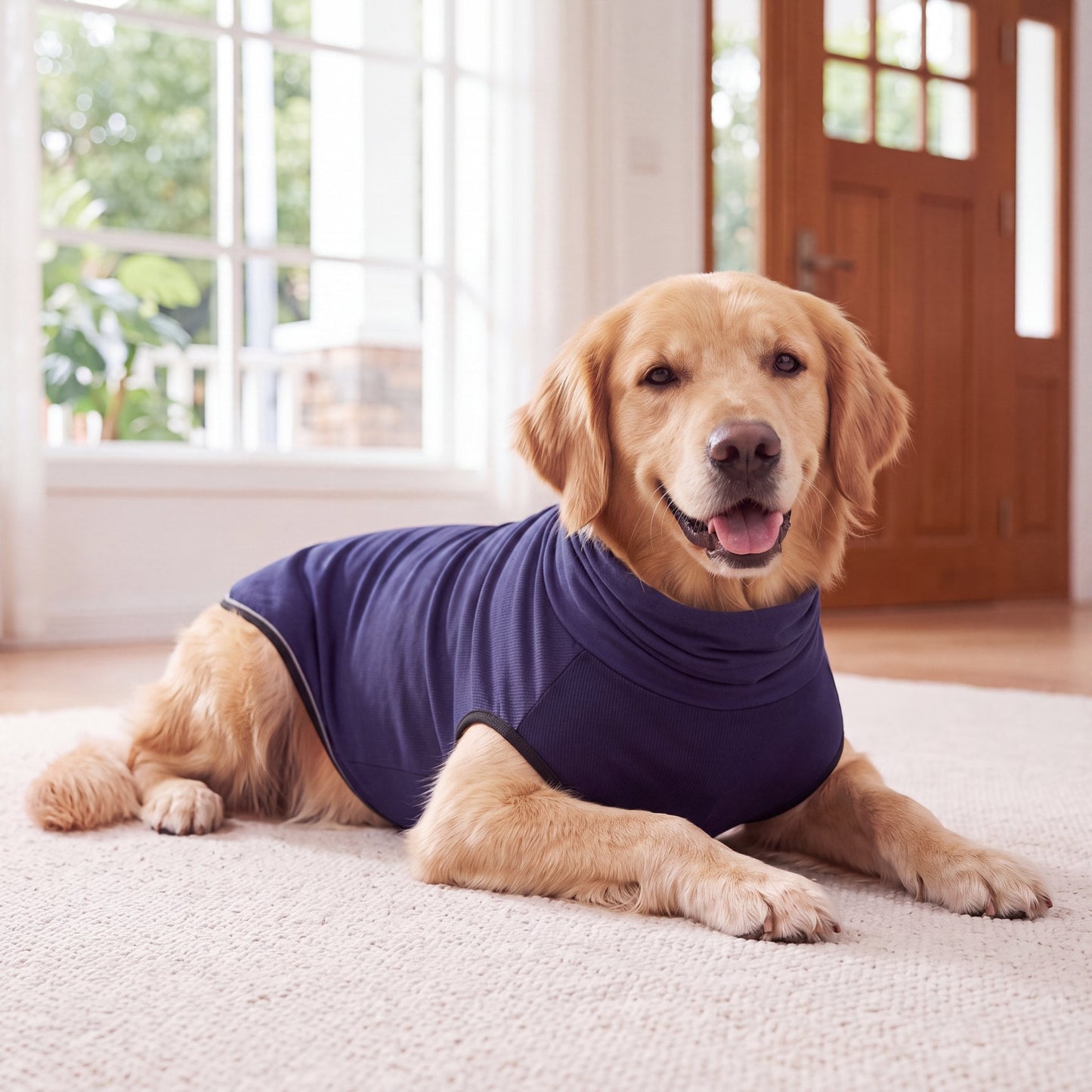
Vesty™ Calming Vest — Calmer in 15 Minutes. On in 30 Seconds.
Vesty™ Calming Vest — Calmer in 15 Minutes. On in 30 Seconds.
Couldn't load pickup availability
Applied automatically at checkout.

Size chart & how to measure

Measure the chest, not the weight — wrap a soft tape around the widest part of the ribcage. Between two sizes? Size up.
| Size | Chest | Neck | Typical breeds |
|---|---|---|---|
| XS | 33–43 cm 13–17" | 27–33 cm | Chihuahua, Yorkie, Pomeranian |
| S | 40–48 cm 16–19" | 31–36 cm | Dachshund, Toy Poodle, Maltese |
| M | 45–54 cm 18–21" | 35–41 cm | Pug, Boston Terrier, Shih Tzu |
| L | 50–60 cm 20–24" | 39–45 cm | French Bulldog, Corgi, Beagle |
| XL | 56–68 cm 22–27" | 42–48 cm | Shiba Inu, Springer, Schnauzer |
| XXL | 65–78 cm 26–31" | 45–51 cm | Border Collie, Aussie, Boxer |
| XXXL | 78–90 cm 31–35" | 48–54 cm | Labrador, Golden Retriever |
Not suitable for dogs with a chest over 90 cm.
See all 7 sizes on real dogs


90 dogs. Three groups. One difference you can measure.
A 2014 trial in the Journal of Veterinary Behavior took 90 dogs diagnosed with separation anxiety or generalized anxiety disorder and split them into three groups: pressure wrap fitted correctly, pressure wrap fitted loosely, and no wrap at all.
Each dog was then left alone, and their heart rate was measured.
The dogs wearing it correctly showed a significantly smaller rise in heart rate than either of the other groups — measured after fifteen minutes. They also spent less time staring at the door.
An earlier trial at Tufts Cummings School of Veterinary Medicine found a pressure wrap was 89% effective for thunderstorm phobia specifically — a narrower question than the broad owner surveys further down this page, which is why that number is higher.
This isn't a claim about how the vest feels. It's a number that came off a heart-rate monitor.
$180 a year. $2,600 a year. Or $49, once.
A large owner survey rated every common treatment for firework fear. Here's where they landed, what a year of each one costs, and what each one asks of you.
| What you try | Rated effective | Year one | What it takes |
|---|---|---|---|
| Pheromone diffuser | 27–35% | $180–300 | Refill every month |
| Herbal drops, treats | 27–35% | $180–480 | Dose daily, reorder monthly |
| Homeopathy | 27–35% | $180–300 | Reorder, forever |
| Noise gel (Sileo) | 74% | $170–380 | Prescription, vet visit, dose before every storm |
| Behavior training | 70% | $840–2,600 | 8–16 weeks, daily, don't leave the dog alone |
| Pressure vest | 44% | $49 · then $0 | Put it on. That's it. |
How those figures are worked out. Diffusers and supplements at $15–40 a month, twelve months. Sileo at $37 a syringe — the gel expires a few weeks after opening, so a year of scattered storms means buying it three or four times, plus one vet visit at the US median exam fee of $86. Training at 12–20 sessions, $70–130 each, which is what noise fear and separation anxiety typically need.
Training beats the vest on effectiveness. So does the prescription gel. If you have four months and a trainer's fee, or a vet appointment and a fresh syringe for every stretch of noisy weather, those are better odds.
The vest rated 44% — higher than any of the calming products above it. The diffusers, the drops and the treats scored no better than a placebo, and they charge you every month for it.
The most expensive thing on this list runs $2,600 in year one. The cheapest still costs $180 — and then it starts year two.
This is $49. There is no year two.
Everything above the last row asks something of you every week. This asks thirty seconds, once.
Here's what a normal evening looks like again.
The shaking stops.
The pacing stops. He lies down instead of walking the same line across the floor for an hour.
He falls asleep with the fireworks still going. Not because the noise stopped. Because he stopped bracing for it.
He stops howling when you're out.
And you sleep too. The whole house gets through the storm, not just the dog.
Some dogs start lying on it when it isn't on them. Left folded on the floor, it becomes the thing they choose.
▸ And how are you holding up?
In 2026, researchers asked 565 people living with a dog like yours how they were doing. 78% said it wore them down. 33% were anxious enough to be flagged by a standard test. 40% said they felt cut off from other people.
Here's the part worth knowing. The owners who struggled most weren't the ones with the worst-behaved dogs. They were the ones who blamed themselves.
It isn't your fault. A dog who panics at a bang isn't a verdict on you. And wanting your evening back doesn't make you a bad owner.
Here's the part that matters most. A dog who has stopped panicking isn't the finish line — it's the start of one. What we want is both halves: him calm enough to enjoy the evening, and you calm enough to enjoy watching him. Not one or the other. Both, at the same time, on an ordinary Saturday night.
Why it works: pressure gets through when words don't.
You can't talk a frightened dog out of being frightened. His nervous system has already decided, and telling him it's fine doesn't reach the part of the brain making that call.
Steady pressure across the body skips the argument completely. It's the same idea behind swaddling a baby and behind weighted blankets — it works on the body's calming response directly. Your dog doesn't have to understand it, obey it, or be trained for it.
That's all this vest does. It wraps snugly around the chest and belly and stays there: a steady hug that never gets tired and never gets distracted.
Two fingers, not four.
Snug enough that two fingers slide under the fabric — and no more. That's it. That's the whole technique.
A calming vest that isn't applying pressure is just a shirt. In the study above, the group wearing it loosely got nothing — their heart rates did exactly what the dogs wearing nothing at all did. If you're not sure, tighten it a little, then check your dog can still walk, sit and lie down normally.
Will it help your dog?
✅ Worth trying for:
- Storms and fireworks — the classic trigger, and where pressure wraps do best
- Car rides and vet visits — short, predictable stress you can plan for
- Mild home-alone worry — whining, restlessness, pacing, not full panic
- Rescue dogs settling in — the first weeks when everything is new
- Visitors and doorbells — the barking that won't stop
❌ Not the right tool for:
- Severe separation anxiety — full panic, self-injury, escape attempts. Start with your vet, not a vest
- Dogs who hate being dressed — if the velcro noise or the pressure itself is the problem, this makes things worse, not better
🛡️ 60 days. Full refund. Don't mail it back.
Didn't help your dog? Email us within 60 days with your order number, a photo of your dog wearing it, and a line about what happened. We refund you in full and you don't mail anything back. Keep it, or pass it to someone whose dog might need it.
Wrong size? We replace it — we don't refund it.
Measure the chest and order by the chart. If the vest still doesn't fit, email us the measurement and we'll ship the right size free, and you keep the first one. Sizing isn't a reason to give up on your dog — it's a reason to send you the right vest.
One claim per household, per product. The photo isn't a hoop to jump through — it's how we spot a fit problem we can actually fix, and how we hold our production partner to account when something arrives wrong.
What it's made of, and what that means for you
90% polyester, 10% spandex → Enough stretch to hold steady pressure without limiting movement, so it keeps working while he walks, lies down and rolls over — not just while he stands still.
Breathable fabric → Doesn't trap heat against the body, so you can leave it on for a whole evening instead of taking it off after twenty minutes.
Adjustable velcro → You set the pressure, not the label, so you can dial it in until it actually works for your dog.
Soothing head wrap → Covers the ears to soften sudden noise, which is the difference between flinching at every bang and sleeping through the display.
Wraps chest and belly → Pressure where it counts instead of draped over the back, which is why this calms a dog and a winter coat doesn't.
7 sizes, fitted by chest measurement → Not by weight, because two 30 lb dogs can be built completely differently — and the fit is the whole product.
🚚 Shipping
Free shipping to the US, Canada, Australia and New Zealand. Most orders arrive in 10–14 days (1–3 days processing, then transit).
Questions
Tap any question to open it.
▸ I've already tried a diffuser and calming treats. Why is this different?
Because in the owner surveys, those two scored 27–35% effective — about what you'd expect from a placebo. The same survey rated pressure vests at 44%.
The money works differently too. A diffuser runs $180–300 a year. Calming supplements run $180–480 a year. And they bill you again next year. This is $49 once.
It also has something the others don't: a controlled trial measuring heart rate in 90 diagnosed dogs, not just owner opinion.
▸ Why does one study say 89% and another say 44%?
Because they asked different questions.
The 89% comes from a Tufts trial that looked at thunderstorm phobia only — one trigger, closely observed. The 44% comes from a survey of 1,225 owners covering firework fear across every kind of dog and household, with no researcher in the room.
Narrow, supervised studies almost always produce higher numbers than broad real-world surveys. Both are on this page.
▸ I haven't tried anything yet. Where should I start?
Then you're in a better position than most owners, because you haven't spent anything yet.
The three products people usually buy first — a diffuser, herbal drops, calming treats — all scored 27–35% in owner surveys, and all of them bill you every month. That's $180–480 in the first year alone. Knowing that before you start is worth more than any discount.
If your dog's case is severe, start with your vet. If it's storms, fireworks, car rides or mild home-alone worry, a pressure vest is a reasonable first thing to try: $49 once, thirty seconds to put on, and a refund if it doesn't help.
▸ Isn't training or medication better?
Yes, on the numbers. Behavior training rates around 70% and the vet's noise gel around 74%. We'd rather tell you that than pretend otherwise.
But look at what they ask of you. Training runs 12–20 sessions at $70–130 each — $840 to $2,600 in the first year — spread over 8–16 weeks of daily practice, during which you're told not to leave your dog alone at all. The gel needs a prescription, and the syringe expires a few weeks after opening, so you buy it fresh for each stretch of noisy weather: $170–380 a year, vet visit included.
This is $49 once and takes thirty seconds. For a lot of dogs that's the right trade. If your dog's case is severe, do both — the vest doesn't replace either one.
▸ He destroys things when I'm out. Is he doing it out of spite?
No. Vets are blunt about this one: destroying things while you're gone is panic, not disobedience.
And that guilty look when you walk in — head down, ears flat — isn't an apology for the mess. Dogs can't connect a scolding to something they did an hour ago. What he learned was simpler and sadder: when you come home and the floor looks like that, you get angry. So he braces.
Punishing it makes him more frightened, which makes the next time worse. Around 14% of dogs at typical US vet practices show signs of separation anxiety — you're not alone in this.
▸ Why do you size by chest and not by weight?
Because weight tells you almost nothing about the shape of a dog. A 30 lb Beagle and a 30 lb Whippet need completely different vests, and most sizing charts put them in the same box.
Fit is the whole product here — a loose pressure wrap does nothing at all. So we ask for one measurement instead: a soft tape around the widest part of the ribcage, just behind the front legs. Thirty seconds, and the guesswork is gone.
If you measure and the chart still lets you down, we ship you the right size free.
▸ Is it safe? Can it hurt him?
A 2024 review of pressure-wrap studies found no adverse side effects reported anywhere in the published research. It's fabric and gentle pressure — nothing to swallow, absorb or react to.
Common-sense limits: take it off every 1–2 hours on long wears and check the skin underneath, take it off overnight, and don't use it on open sores, skin infections or recent surgical wounds.
▸ How fast will I see a difference?
In the controlled study the effect was measured after 15 minutes. Some owners see a settled dog the first time they put it on.
For others it takes a few tries, because the vest is a new sensation. Introduce it on a calm day for 10–15 minutes, not in the middle of a panic — a dog who first meets the vest during fireworks may connect it to the fear instead of the relief.
▸ My dog hates having things put on him
Try it on for one minute in a quiet room, with treats. Most dogs accept it quickly once it's on and the pressure settles them.
If he freezes, shakes or refuses to move, take it off — for a small number of dogs the sensation itself is the problem. The guarantee covers you.
▸ Will he overheat in it?
The fabric is breathable and the vest is thin, so indoors at normal room temperature it's fine for a few hours.
Don't use it outdoors in hot weather, on a flat-faced breed in summer, or over a thick double coat in a warm room. Any extra layer makes it harder for a dog to cool down. If he starts panting harder with it on, take it off.
▸ Will it work for separation anxiety specifically?
The 2014 study included dogs diagnosed with separation anxiety and measured a real reduction in heart-rate rise while they were alone. So yes, there's evidence behind it.
It works best alongside gradual departure training. If your dog panics the moment you're out of sight, hurts himself, or destroys doors and windows, that's a case for your vet or a behaviorist first.
▸ Can I use it with medication my vet prescribed?
It's a garment, not a drug — there's nothing to interact with. Many owners use both, and pressure wraps are commonly suggested as part of a wider plan.
Never stop or reduce prescribed medication because of this vest. That conversation belongs with your vet.
▸ Does the head wrap have to be used?
No. Some dogs settle better with their ears covered, others hate it. Try the vest on its own first, then add the head wrap for noise triggers if your dog is fine with it. Never pull it over the eyes.
▸ Can I wash it?
Cold wash, air dry. Don't put it in the dryer — heat breaks down the spandex, and once it stops stretching evenly it stops applying even pressure.
▸ Is this a medical device?
No. It's a pressure garment. It does not diagnose, treat or cure anxiety, and it does not replace veterinary advice or prescribed medication. Results vary between dogs — nothing on this page is veterinary advice.
Cottam N, Dodman NH, Ha JC. J Vet Behav (2013). · King C, Buffington L, Smith TJ, Grandin T. J Vet Behav 9(5):215–221 (2014). · Riemer S. Effectiveness of treatments for firework fears in dogs. J Vet Behav 37:61–70 (2020); n=1,225 owners; the 44% figure refers to pressure vests as a category, not to this product specifically. · A Systematic Review of the Efficacy of Compression Wraps as an Anxiolytic in Domesticated Dogs (2024). · Beyond the Behavior: Caregiver Guilt, Burden, and Well-Being Among Owners of Dogs with Behavior Problems. Pets 3(2):22 (2026); n=565 owners. · Cost figures are 2026 US retail: Sileo 3 mL syringe $37; US median vet exam fee $86 (typical range $58–160); dog trainer sessions $70–130. Your own costs will vary by location and by how noisy your year is.